
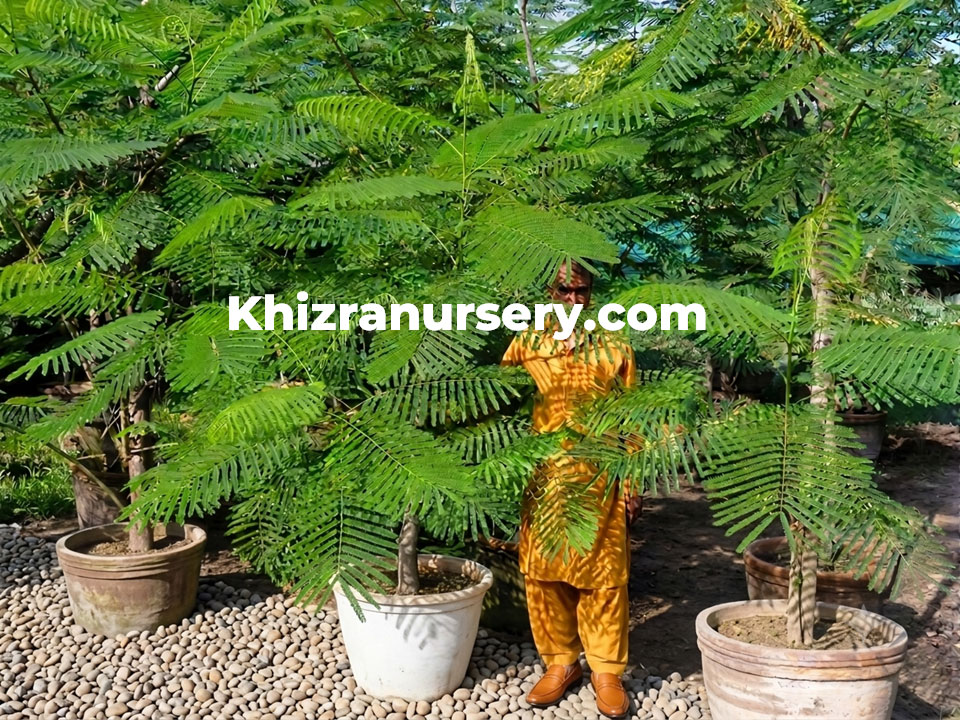
Delonix regia Trees for Sale
Delonix regia, commonly known as Royal Poinciana, Flamboyant Tree, Flame Tree, or Gulmohar, is one of the world’s most spectacular flowering trees. Native to Madagascar, it is now widely cultivated throughout tropical and subtropical regions for its brilliant red to orange-red flowers, broad spreading crown, and attractive fern-like foliage.
Royal Poinciana is particularly popular for large gardens, parks, avenues, roadsides, open lawns, and other landscape settings where its wide canopy and dramatic flowering display can be fully appreciated.
Delonix regia Plant Characteristics
Delonix regia is a fast-growing, broad-canopied deciduous tree that can develop a wide, spreading or umbrella-shaped crown. Under favorable conditions, mature trees can become approximately 10–15 meters tall, with the canopy often spreading considerably wider than the height.
The leaves are large and finely divided into numerous small leaflets, giving the tree a soft, fern-like appearance. The delicate foliage provides attractive filtered shade during the growing season.
Its broad crown makes Royal Poinciana an excellent shade tree, but it also means that sufficient open space should be provided when selecting a planting location.
Royal Poinciana Flowers
The spectacular flowers are the main attraction of Delonix regia. The tree produces large clusters of bright red, scarlet, or orange-red flowers, with the upper petal typically marked with a contrasting white to creamy-yellow area and red markings.
When the tree reaches peak flowering, the colorful blooms can cover much of the canopy, creating a dramatic display. This is why Royal Poinciana is widely regarded as one of the most impressive flowering shade trees for tropical and subtropical landscapes.
Delonix regia Foliage and Seed Pods
The foliage consists of long, bipinnate leaves with numerous small leaflets. The fine texture of the leaves creates a light, airy appearance compared with trees having large, solid leaves.
After flowering, long, flat, woody seed pods develop. These pods can reach approximately 40–70 cm in length and contain numerous seeds.
The pods can remain on the tree for an extended period, adding another distinctive feature to mature specimens.
Growing Delonix regia
Delonix regia performs best in warm tropical and subtropical climates, with plenty of sunlight and well-drained soil. It is highly suitable for areas with hot summers and can tolerate periods of dry conditions once established.
For healthy growth:
- Plant in full sun.
- Choose well-drained soil.
- Provide regular irrigation while young.
- Allow the soil to dry appropriately between irrigation once established.
- Give the tree plenty of room for its wide crown.
- Prune young trees to develop a strong framework.
- Avoid planting directly beside buildings, paving, drains, or other structures.
Royal Poinciana develops a wide-spreading root system, and its branches can be susceptible to breakage. Careful site selection and structural pruning are therefore important for long-term landscape performance.
Royal Poinciana Uses in Landscaping
Delonix regia is an excellent ornamental tree for a variety of large-scale landscape applications, including:
- Large home gardens
- Parks
- Public gardens
- Roadsides
- Avenues
- Open lawns
- Resorts
- Commercial landscapes
- Institutional grounds
- Specimen planting
- Shade planting
Its broad crown and spectacular flowers make it particularly effective when planted as a feature or specimen tree in an open area.
Delonix regia as a Shade Tree
Royal Poinciana is valued not only for its flowers but also for the shade produced by its broad canopy. The fine foliage allows filtered light through the crown, creating a pleasant shaded environment during the growing season.
Because the mature crown can become very wide, Delonix regia is best planted where it has enough room to spread without interfering with buildings, roads, underground infrastructure, or paved areas.
Royal Poinciana for Streets and Avenues
Delonix regia has been widely planted along streets, avenues, parks, and public landscapes in tropical and subtropical regions. Its flowering canopy can create an impressive visual effect when several trees are planted in a suitable landscape design.
For roadside or avenue planting, adequate distance from buildings and pavement is important because of the tree’s broad roots and mature canopy.
Delonix regia Tree Care
Royal Poinciana is relatively easy to grow when planted in an appropriate warm climate. Full sunlight, good drainage, adequate moisture during establishment, and sufficient space are the key requirements.
Young trees benefit from formative pruning to establish a strong trunk and well-balanced branches. Regular inspection and pruning can also help manage weak or poorly positioned branches as the tree develops.
Buy Delonix regia Trees from Khizra Nursery
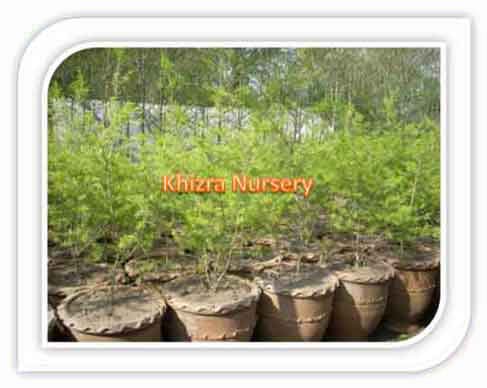
Khizra Nursery supplies Delonix regia trees for sale, also known as Royal Poinciana, Flamboyant Tree, Flame Tree, and Gulmohar.
These flowering trees are suitable for gardens, parks, avenues, large lawns, commercial landscapes, resorts, specimen planting, and large landscaping projects.
Contact Khizra Nursery for available sizes, quantities, pricing, and worldwide shipping arrangements. Bulk quantities can be supplied for larger landscaping and planting projects.
Frequently Asked Questions
What is the botanical name of Royal Poinciana?
The botanical name is Delonix regia (Bojer ex Hook.) Raf. It belongs to the family Fabaceae.
What are the common names of Delonix regia?
Common names include Royal Poinciana, Flamboyant Tree, Flame Tree, Flamboyant, and Gulmohar.
What color are Royal Poinciana flowers?
The flowers are generally bright red, scarlet, or orange-red, with the upper petal often displaying contrasting markings.
How tall does Delonix regia grow?
Delonix regia commonly reaches around 10–15 meters in many landscape settings, although mature size varies according to growing conditions. Some botanical descriptions record trees reaching considerably greater heights.
Is Delonix regia evergreen?
No. Royal Poinciana is generally a deciduous tree, although the timing and extent of leaf loss can vary according to climate and growing conditions.
Does Royal Poinciana need full sun?
Yes. Full sun is recommended for healthy growth and strong flowering.
Is Delonix regia drought tolerant?
Established Royal Poinciana trees have high drought tolerance, although young trees require regular watering while their root systems are developing.
Is Delonix regia suitable for small gardens?
Royal Poinciana is better suited to large gardens and open landscapes because its mature canopy and root system can spread considerably.
Can Delonix regia be used as a roadside tree?
Yes. Royal Poinciana is widely planted along roads, avenues, parks, and streetscapes, provided sufficient space is available for its mature roots and canopy.
Where can I buy Delonix regia trees?
You can buy Delonix regia trees from Khizra Nursery for gardens, parks, avenues, landscaping projects, specimen planting, and bulk requirements, with worldwide supply and shipping options.


Reviews
There are no reviews yet.