
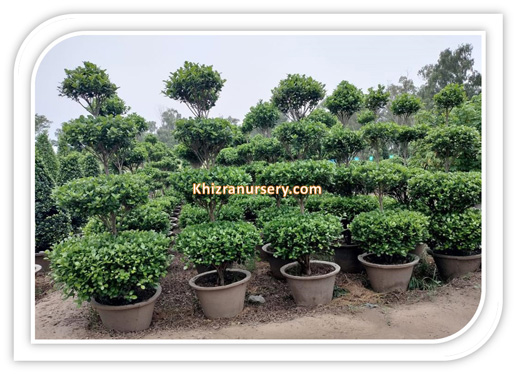


Ficus microcarpa Trees For Sale
Ficus microcarpa, commonly known as the Chinese Banyan, Indian Laurel Fig, Malayan Banyan, or Curtain Fig, is an attractive evergreen tree from the Moraceae family. It is valued for its dense foliage, spreading canopy, strong trunk, and ability to develop an impressive mature form. The species is native to tropical and subtropical regions of Asia and the western Pacific.
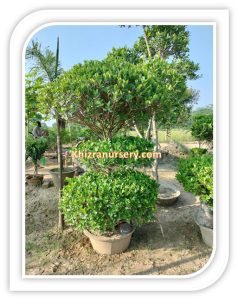
Ficus microcarpa is widely used as a shade and ornamental tree in gardens, parks, streets, avenues, commercial landscapes, and large outdoor spaces. Its dense evergreen foliage also makes it useful where a permanent green appearance is desired.
Khizra Nursery offers Ficus microcarpa trees for sale for residential landscaping, commercial projects, parks, roadside planting, and large-scale landscape developments. Nationwide shipping across Pakistan and worldwide export for trees are available.
Appearance of Ficus microcarpa
Ficus microcarpa develops into a medium to large evergreen tree with a dense, rounded or spreading crown. Mature trees can develop a substantial trunk and extensive branches, giving them a strong and established appearance in large landscapes.
The leaves are small, glossy, and dark green, forming dense foliage across the branches. The evergreen nature of the tree makes it useful for landscapes where year-round greenery is preferred.
Older trees may develop aerial roots and interesting trunk structures, particularly under warm and humid growing conditions. These features can add considerable ornamental value to mature specimens.
Ficus microcarpa as a Shade Tree
One of the main reasons Ficus microcarpa is planted in landscapes is its dense canopy. When given sufficient space to develop, the tree can provide useful shade and create a cooler, greener environment.
It can be planted in:
- Parks
- Large gardens
- Residential landscapes
- Commercial properties
- Roadsides and avenues
- Institutional grounds
- Public landscaping
- Large lawns
- Shade planting projects
Because mature Ficus microcarpa can develop a broad canopy and substantial root system, it is important to provide adequate space when selecting a permanent planting location.
Landscaping Uses of Ficus microcarpa
Ficus microcarpa is a versatile landscape tree and can be used in different styles of planting. Its dense evergreen foliage makes it suitable as a specimen tree as well as part of larger landscape schemes.
Common uses include:
Parks and Public Spaces
Ficus microcarpa can be planted in parks and public areas where a long-lived evergreen tree with a substantial canopy is required.
Roadsides and Avenues
Its structured growth and dense foliage make it suitable for avenue and roadside landscaping where adequate planting space is available.
Gardens
Large residential gardens can benefit from Ficus microcarpa as a shade or specimen tree. It can serve as a prominent focal point within spacious landscapes.
Commercial Landscaping
The tree is also suitable for hotels, offices, housing developments, educational institutions, and other commercial properties where mature greenery is desired.
Shaping and Pruning
Ficus microcarpa responds well to pruning and shaping, which has also made it popular for ornamental forms and bonsai. Regular pruning can help maintain a desired structure when the tree is grown in a managed landscape.
Growing Ficus microcarpa
Ficus microcarpa is naturally associated with tropical and subtropical environments and generally performs best in warm climates. Kew lists its native range as extending from tropical and subtropical Asia to the western Pacific.
For healthy growth, choose a location with good sunlight and well-drained soil. Young trees benefit from regular moisture while establishing their root systems.
Once established, Ficus microcarpa can develop into a strong and relatively low-maintenance landscape tree when planted in a suitable location.
Soil Requirements
Ficus microcarpa grows best in fertile, well-drained soil. Good drainage is particularly important because prolonged waterlogging can negatively affect root health.
Before planting, improve poor soil with suitable organic matter where necessary. The planting area should allow excess water to drain away rather than remaining around the roots.
Watering Ficus microcarpa
Young Ficus microcarpa trees should be watered regularly during their establishment period. The frequency of watering depends on the climate, soil type, rainfall, and planting location.
Once established, the tree generally requires less frequent watering. During periods of hot or unusually dry weather, additional irrigation can help maintain healthy growth and foliage.
Avoid keeping the soil continuously saturated.
Sunlight Requirements
Ficus microcarpa performs well in bright conditions and is suitable for sunny outdoor locations. Good sunlight helps support dense foliage and strong growth.
When planting multiple trees, allow sufficient spacing so that each tree has enough room to develop its canopy.
Pruning and Maintenance
Regular pruning can be used to remove dead, damaged, or unwanted branches and to maintain the desired shape. Ficus microcarpa is also valued for its ability to tolerate shaping, making it useful for managed landscape designs.
When planting the tree as a large shade tree, avoid excessive pruning that unnecessarily restricts its natural canopy development.
Pruning should also take into account nearby buildings, pathways, utility infrastructure, and other trees.
Planting Ficus microcarpa Trees
Choose a permanent planting location with enough space for the tree’s future canopy and root development.
Dig a planting hole wider than the root ball and place the tree at approximately the same depth at which it was growing in its nursery container or bag. Backfill with suitable soil and water thoroughly after planting.
Mulching around the base can help conserve soil moisture and reduce competition from weeds. Keep mulch away from direct contact with the trunk.
Ficus microcarpa Trees for Sale
Khizra Nursery offers Ficus microcarpa trees for sale for gardens, parks, roadsides, avenues, commercial landscaping, institutional grounds, and large landscape projects.
Ficus microcarpa is an excellent choice for customers looking for an evergreen tree with dense foliage, a spreading canopy, and strong ornamental appeal.
Trees can be supplied for individual landscaping requirements as well as larger plantation and commercial projects.
Nationwide shipping across Pakistan and worldwide export for trees are available from Khizra Nursery.
Ficus microcarpa – Quick Facts
- Botanical Name: Ficus microcarpa L.f.
- Family: Moraceae
- Common Names: Chinese Banyan, Indian Laurel Fig, Malayan Banyan, Curtain Fig
- Plant Type: Evergreen tree
- Native Range: Tropical and subtropical Asia to the western Pacific
- Foliage: Dense, glossy green and evergreen
- Growth Habit: Upright with a dense, spreading canopy
- Uses: Shade, gardens, parks, avenues, roadsides, landscaping
- Landscape Use: Specimen tree, shade tree, avenue planting, ornamental planting
- Pruning: Suitable for shaping and maintenance
- Delivery: Nationwide shipping and worldwide export for trees
Frequently Asked Questions
What is Ficus microcarpa?
Ficus microcarpa is an evergreen tree in the Moraceae family, commonly known as the Chinese Banyan or Indian Laurel Fig. Its native range extends across tropical and subtropical Asia to the western Pacific.
What is the common name of Ficus microcarpa?
Ficus microcarpa is commonly known as Chinese Banyan, Indian Laurel Fig, Malayan Banyan, and Curtain Fig.
Is Ficus microcarpa a shade tree?
Yes. Ficus microcarpa can develop a dense, spreading canopy and is commonly used as a shade and landscape tree where sufficient space is available.
Is Ficus microcarpa evergreen?
Yes. Ficus microcarpa is an evergreen tree with dense green foliage, making it suitable for landscapes where year-round greenery is desired.
Where can Ficus microcarpa trees be planted?
Ficus microcarpa can be planted in large gardens, parks, roadsides, avenues, commercial properties, institutional grounds, and other spacious landscape areas.
Can Ficus microcarpa be pruned and shaped?
Yes. Ficus microcarpa tolerates pruning and shaping, which makes it suitable for managed landscapes and ornamental forms.
Does Ficus microcarpa need full sun?
Ficus microcarpa performs well in bright, sunny outdoor locations. Good sunlight supports healthy growth and dense foliage.
How should Ficus microcarpa be watered?
Young trees should receive regular watering during establishment. Established trees generally require less frequent irrigation, with additional watering beneficial during prolonged dry periods.
Does Khizra Nursery offer Ficus microcarpa trees for sale?
Yes. Ficus microcarpa trees are available for sale from Khizra Nursery for landscaping, parks, gardens, roadsides, and commercial projects, with nationwide shipping and worldwide export for trees.






















Reviews
There are no reviews yet.